

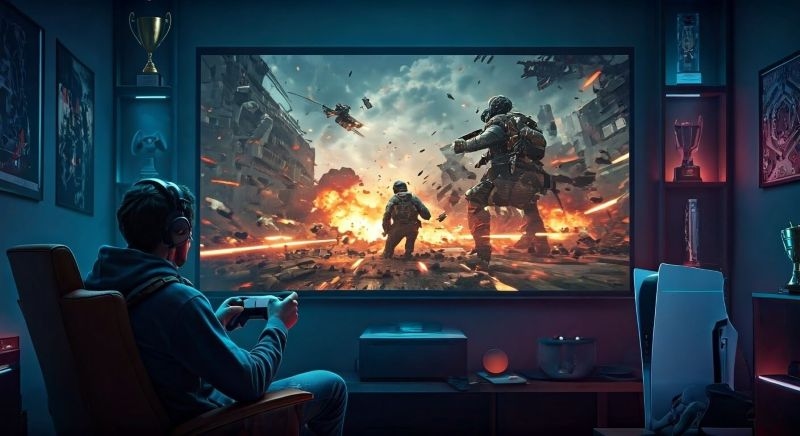
Gaming does not look the same anymore. Bigger screens are no longer limited to living room TVs, and monitors are not the default choice for everyone. More players are switching to projectors because they want scale, immersion, and flexibility.
The problem is that most projectors are still designed for movies, not gameplay. The best projector for gaming has very specific requirements, and missing even one of them can ruin the experience. This article focuses on what actually matters in a gaming projector 2026, without marketing fluff or spec chasing.
If you only remember one thing, it should be this. Gaming performance comes before image polish.
Input lag is the delay between your controller input and the image reacting on screen. For gaming, this is more important than resolution, contrast, or HDR.
A low input lag projector for gaming should stay under 20 milliseconds. Anything higher becomes noticeable, especially in shooters, sports games, and racing titles. Some projectors look impressive but add heavy image processing that slows everything down.
If a manufacturer does not clearly state input lag numbers, assume they are not targeting gamers.
Fast motion exposes weak projectors immediately. A good gaming projector 2026 should support at least 120Hz at lower resolutions, even if 4K is capped at 60Hz.
Higher refresh rates reduce blur, keep fast scenes readable, and make gameplay feel smoother. This matters even in single player games where camera movement is constant.
Resolution only matters if the screen is large enough to show the difference.
This is why many players now look for the best gaming projector 4K. Large screens expose softness quickly, especially in text heavy games or detailed environments.
Top pick: Top Gaming Trends: What’s Changing the Industry?
Projector brightness is not just a number on a box. It decides whether your screen looks sharp or washed out.
For gaming, 3000 lumens or more is a safe range unless you play in a fully dark room. Living rooms, shared spaces, and daylight gaming all demand higher brightness.
Color accuracy matters more than exaggerated saturation. Natural colors improve visibility and reduce eye strain during long sessions.
The best projector for gaming must work properly with modern hardware.
At minimum, it should support:
HDMI 2.1 is ideal but not mandatory for everyone. What matters is consistent performance without signal dropouts or forced image processing.
A low input lag projector for gaming often includes a dedicated game mode that bypasses unnecessary enhancements. This should always be enabled.
Explore More: Future of Mobile Gaming: Trends Shaping the Next Era
Not every gamer needs the same type of projector. Your room and playstyle matter more than brand names.
If you play story driven games, RPGs, or open world titles, immersion matters. A best gaming projector 4K makes sense here, especially with a screen above 120 inches.
These setups prioritize image clarity and scale over extreme competitive response times.
For shooters and sports games, response time matters more than resolution. Some 1080p and hybrid 4K models deliver extremely low lag and higher refresh rates.
This is where a low input lag projector for gaming outperforms more cinematic models.
Short throw projectors are practical in limited spaces. They allow large images from short distances and reduce shadow issues.
For apartments or desk setups, this type of gaming projector 2026 is often easier to live with.
Many players blame the projector when the issue is setup.
This is the most common mistake. Without game mode, input lag increases and responsiveness drops. Always enable it, even if the image looks slightly less polished.
Walls reflect light unevenly. A basic projector screen improves sharpness, brightness, and contrast immediately.
If you invest in the best projector for gaming, a screen should not be optional.
Even the brightest best gaming projector 4K looks better with controlled lighting. Curtains or blinds make a noticeable difference, especially for HDR content.
TVs still work better in very bright rooms and for smaller screen sizes. They also tend to have lower input lag by default.
Projectors win on scale. Racing games, cinematic titles, and split screen multiplayer feel completely different on a 120 inch display.
For many players, a gaming projector 2026 replaces a TV entirely.
Don’t Miss: Next-Gen Gaming Consoles: PlayStation 6 and Xbox Future
The best projector for gaming is not about chasing the highest specs. It is about choosing a projector that fits your room, your hardware, and the way you play.
If you want long term value and visual clarity, a best gaming projector 4K makes sense. If you care about speed and responsiveness, prioritize a low input lag projector for gaming even if resolution takes a back seat.
Gaming projectors have matured. In 2026, they are no longer a compromise. For the right setup, they are an upgrade.
The best projector for gaming in 2026 combines low input lag, stable refresh rates, and enough brightness for real room conditions. Models built specifically for gaming outperform general home theater projectors.
A best gaming projector 4K is worth it for large screens and modern consoles. The added sharpness becomes noticeable above 100 inches and improves long term value.
A low input lag projector for gaming should stay under 20 milliseconds. Competitive players usually aim for 10 milliseconds or lower for fast paced games.
This content was created by AI